Why Design Management matters now!
“AI is making our degrees useless"“AI is taking away my job!”
I hear these anxieties all the time from friends and students when the topic of AI comes up. In an economic downturn and a tough job market, it’s easy to assume that a technology wave is rendering our skills obsolete. Universities can’t teach fast enough to keep up — I know this first as a lecturer — and many companies still lack a clear strategy.
The AI adoption boom (and what’s missing)
In 2025, approximately 88% of organisations's report regular use of artificial intelligence in at least one business function, up from 78% in 2024. Furthermore, 72% of companies are using generative AI specifically. However, this broad adoption masks a significant "maturity gap": only about 1% of business leaders describe their generative AI implementations as "mature," and roughly two-thirds of organisation's remain stuck in an experimentation or "pilot loop," struggling to capture enterprise-level value 2024, thus, for the majority of organisations, AI has not yet produced a substantial impact on the bottom line (McKinsey, 2025).
If that feels familiar, think of it like buying an industrial‑grade oven and still making toast. You’ve invested in powerful infrastructure, but if you keep following the same recipes and processes, nothing really changes. Likewise, buying high‑end art supplies doesn’t make you an artist. It’s the person behind the canvas who creates value.
The result is a landscape where many beloved brands sprinkle AI into everything without much thought. Companies are lacking Design Management skills - that’s what’s missing.
Design Management: more than aesthetics
“Simply put, design management is the business side of design” - Design Management Institute (2018). It encompasses the ongoing processes, decisions and strategies that link design, innovation, technology, management and customers to create well‑designed products, services and experiences. In other words, it’s not just about how something looks; it’s about aligning design with business goals to generate economic, social and environmental value.
Without this discipline, AI adoption can become chaotic. Tools get bolted onto old processes, and flashy features replace a clear understanding of customers’ needs. Design management provides the framework to connect AI initiatives to real human problems and business outcomes.Integrating design management into AI strategies
So how do we do that? A few principles:
Start with people, not technology. Identify the pain points you actually want to solve. Most people don’t need another chatbot or auto‑summary. Workers won’t magically become more productive just because you give them a tool; they need the right training and context.
Apply design thinking to management processes. Observe your customers and your teams to understand where friction exists. Brainstorm solutions together, prototype and test them, then refine. Treat AI like any other design component: it should serve the user, not the other way around.
Combine design thinking, lean startup and agile. Rapid iteration, feedback loops and cross‑functional collaboration accelerate learning and reduce waste. Gartner’s guidance to weave these methods together is still valid — the cycle simply runs faster now.
Rewire workflows, don’t just bolt on tools. High‑performing companies redesign processes to take advantage of AI . That can mean reworking a sales playbook, rebuilding a support runbook or re‑platforming content so that AI can operate reliably.
By following these steps, design management becomes the bridge between human needs and technological capabilities. It ensures that AI deployment isn’t just about catching up with competitors but about creating meaningful improvements for customers and employees.
The process of how Design Thinking and Lean Start Up is coming together is also still true and shouldn’t be forgotten. The process is only happening at a faster pace.
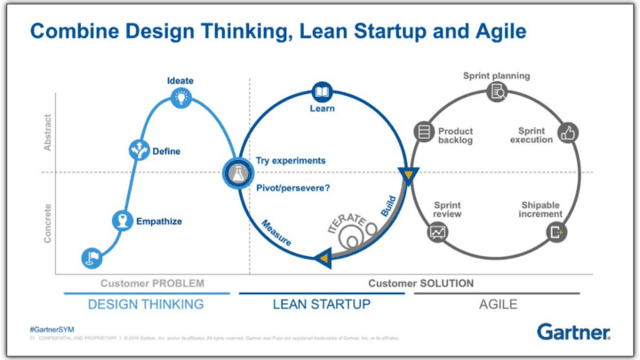
Combine Design Thinking, Lean Startup and Agile. Gartner (2024)
In conclusion…
Yes, many companies feel lost right now. But that doesn’t mean we should wait around for them to figure it out. The demand for skilled AI practitioners has never been higher. Being “average” is no longer enough. You can’t expect to land a job and slowly grow into it as before. Organisations don’t have the time or expertise to train you, because they’re also figuring things out.
The famous line is true: “AI is not stealing your job, but someone who uses AI will.” I’ve seen it happen. Instead of fearing the technology, focus on understanding how to use it strategically, empathetically and responsibly. That’s where design management shines.
Design Management Institute. (2018). What is Design Management? Dmi: Design Management Institute. Abgerufen am 19. Dezember 2025, von https://www.dmi.org/page/what_is_design_manag#:~:text=Design%20management%20encompasses%20the%20ongoing,life%20and%20provide%20organizational%20success.McKinsey. (2025, 5. November). The state of AI in 2025: Agents, innovation, and transformation. Abgerufen am 19. Dezember 2025, von https://www.mckinsey.com/capabilities/quantumblack/our-insights/the-state-of-ai